
Warning: Undefined variable $before in /home/pmed/public_html/wp-content/themes/divi-spm/jmg_functions.php on line 27
Click images to view full size originals.
 Last weekend I stumbled across the “attic” of Tom Ferguson MD, who was the “George Washington of patient empowerment,” as CNN put it this month, citing his work since 1975 to create a world of freedom and power for patients.
(Patients? That’s you. Thank him.)
Those familiar with this blog know about the white paper DocTom’s team completed after his death in 2006. But I didn’t know some of his earlier writings are around on www.DocTom.com, a modest web site including a few old slide shows. They’re sans speaker notes, but the good stuff is the images: you can get the drift.
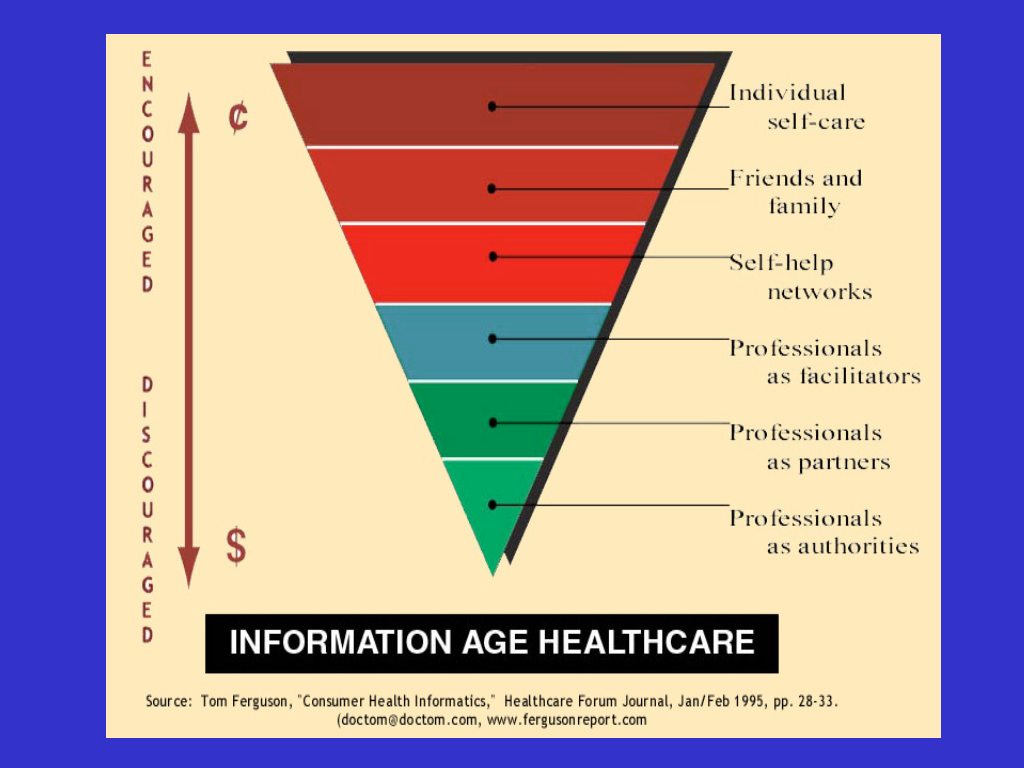
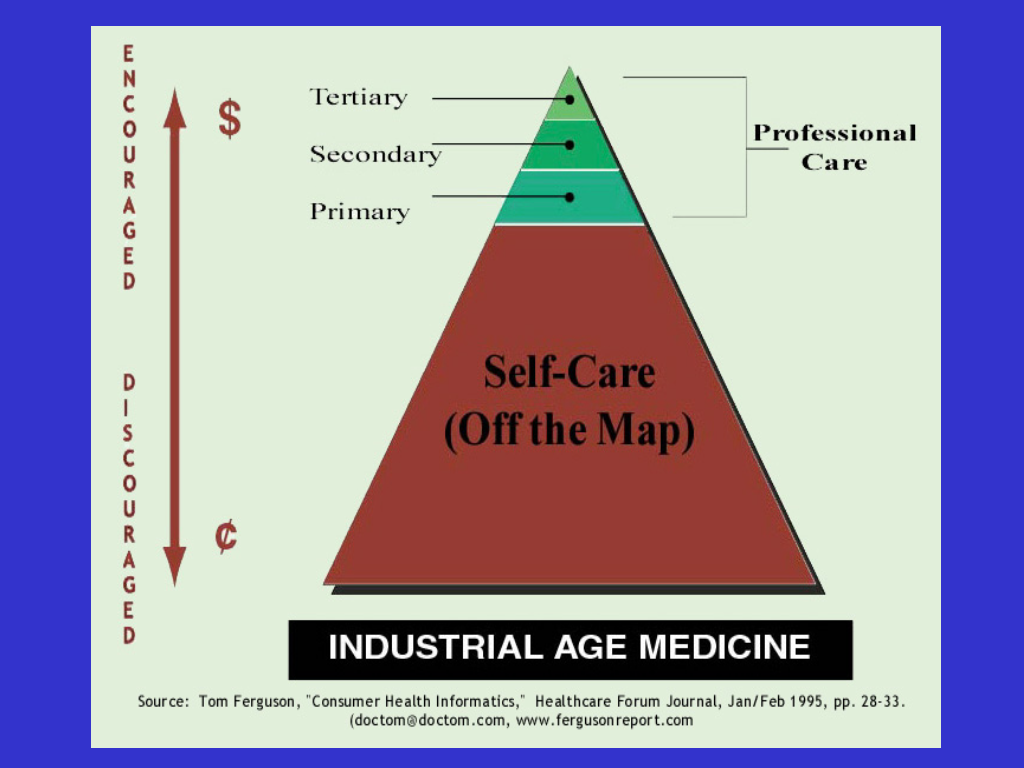
My favorites (above) are #88 and #89 from his 2003 slides. Here’s my narrative:
In the industrial age, the means of production and ability to create value were centralized in massive facilities. If you didn’t own the factory, you didn’t have freedom and power.
In the information age, those with access to information have access to power and can create value.
Those slides were made in 1995, when the Web had just been born, but they hit the nail on the head: today we have access to tremendous resources, and that empowers and enables us.
Please don’t interpret these slides as meaning that in the world of the future there will be no doctors. That’s idiotic. Rather, Tom’s vision is that “we the people” have a lot more ability to contribute than was once thought. And both costs and quality can improve as a result.
Compelling evidence to support this was collected into the white paper (above). Further independent evidence from around the world is provided by PCPCC (the Patient Centered Primary Care Collaborative), about which I wrote on my blog in May, including a few of their slides.
Steal these slides. Show them to others, put them in your decks when you give talks. And look at those PCPCC slides, with their data on cost and quality. It’s a new world out there – feed your head!



FYI: The RSS subscription link on the homepage is pointing to an invalid Feedburner page. The links embedded in the head of your pages works great, though.
Thanks for letting us know about this. Don’t know what went wrong – we’ll fix it asap.
Stolen!
We should have made more progress in 13 years. Let’s fix that.
Hi
I know we are very sadly only left with the slides but it would be great of someone could explain more about the encouraged/discouraged scale on each slide. What were the factors encouraging a drive towards tertiary care before and against it now/in the future? I ask because to me that is probably the social and cultural factors around system change are probably the most important and the hardest to change.
I’m also curious as to whether the same factors are relevant in the UK as in the US ie how much does the funding of healthcare determine which slide we are on?
Thanks,
Anne Marie
I love the description of Tom as a founding father of patient engagement. His message will never grow old. And thanks to these slides, successive generations of consumer and patient empowerment advocates will always have a place to start from and return to as they move through the evolving eHealth landscape.
Mary Jo, coming from a person like you, that’s a terrific acknowledgement of Tom’s work. Thanks!
On Twitter today (6.5 years later!) I saw an updated version of these slides – which appeared in the BMJ, 2010! “Adoption, non-adoption, and abandonment of a personal electronic health record: case study of HealthSpace”