by Susannah Fox | Feb 9, 2013
For over a year I’ve been the accidental manager of a community garden. All I did — I swear — is point out an open plot of land and people started pitching in, planting, asking friends to join them. All of a sudden we’d transformed a bare patch...
by e-Patient Dave | Nov 7, 2011
“Patients are overwhelmingly interested in gaining rapid access to their notes … doctors have not experienced significant disruptions to their work.” Hear hear! That’s from a new commentary published Monday in Modern Healthcare about the...
by e-Patient Dave | Mar 23, 2010
Updated 3/12/2014 with new links at bottom. One of my personal pleasures in the first year of the Society for Participatory Medicine has been discovering people in other parts of the “patient culture” who’ve been doing wonderful, empowering,...
by Susannah Fox | Nov 8, 2009
I scan menus for keywords (fig, parsnips, salmon…) and it turns out I scan Twitter the same way, looking for anyone who is talking about my favorite topics (data, consumers, information quality…) So when I saw Jonathan Richman’s tweet the other...
by Gilles Frydman | May 18, 2009
Comparative Effectiveness: a comparison of the impact of different options that are available for treating a given medical condition for a particular set of patients. Such studies may compare similar treatments, such as competing drugs, or they may analyze very...

 Driving Transformation: Change Management Strategies for Integrating Participatory Medicine in HealthcareApril 6, 2024
 The Challenge for Medicare Part D Patients: Inability to Utilize Pharmaceutical Programs to Reduce Medication CostsMarch 29, 2024
 Shared Decision-making: Becoming a Better Advocate for your HealthcareMarch 28, 2024
 2024 SPM Update from Board Chair Mary HenningsJanuary 17, 2024
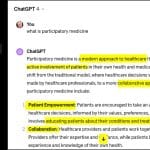 Hey ChatGPT, what’s Participatory Medicine?November 20, 2023
Recent Comments